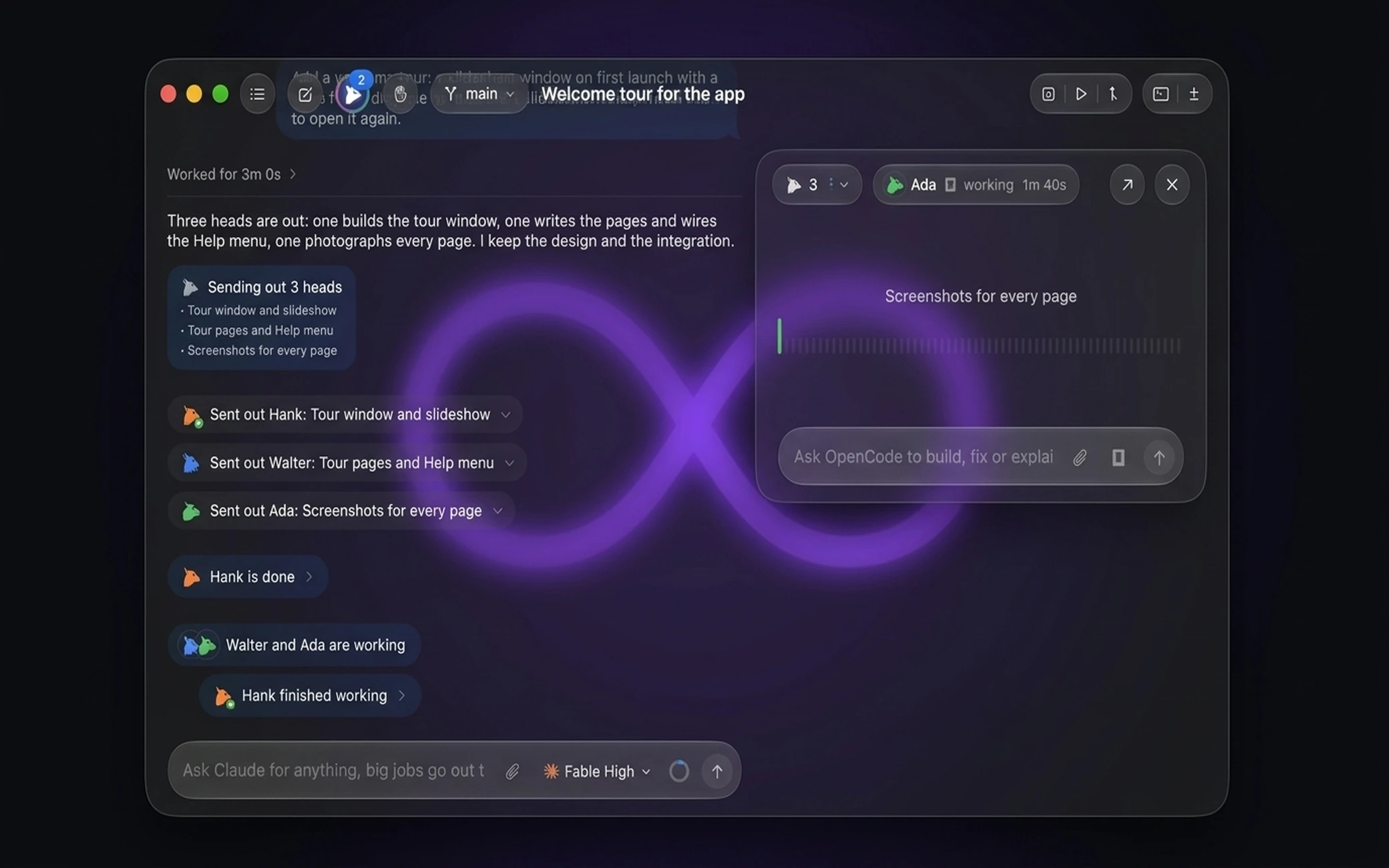
For months, the most requested feature from engineers using Ensembyte was parallel agents. In complex real-world codebases, a single agent working sequentially is bottlenecked. When you refactor a core database schema, write unit test suites, and update OpenAPI contracts, doing each step sequentially takes minutes of waiting while watching a loading spinner.
Every conventional coding session follows a rigid sequential cycle: you prompt, the LLM deliberates, emits diffs, waits for tool validation, and asks for review. If you have 3 distinct tasks that could easily execute concurrently, a serial agent forces you to wait for Task 1 before starting Task 2. This linear latency degrades engineering velocity.
Hydra breaks this paradigm completely. Instead of one single agent executing in your working directory, Hydra uses a Hub-and-Spoke Swarm architecture built natively on Git worktrees:
# How Hydra spawns isolated agent worktrees behind the scenes:
git worktree add -b hydra/head-auth ~/.ensembyte/worktrees/agent-auth origin/main
git worktree add -b hydra/head-tests ~/.ensembyte/worktrees/agent-tests origin/main
git worktree add -b hydra/head-docs ~/.ensembyte/worktrees/agent-docs origin/main

# Each head operates in strict filesystem isolation — 0 file collisions!
The lead agent decomposes your overarching goal into discrete, self-contained briefs with strict interface contracts. It dispatches helper heads simultaneously. Head #1 works on authentication logic, Head #2 writes test suites, and Head #3 generates documentation. Because each head works inside an isolated git worktree on its own branch, they never overwrite each other's uncommitted buffers.
When each head finishes, it returns a structured git diff back to the lead. The lead reviews every change, verifies unit tests pass across all heads, resolves semantic overlap, and commits the combined work as one unified checkpoint directly into your main branch. Once landed, Hydra cleanly prunes the temporary worktrees with zero disk garbage left behind.
Effort Tuning: In Hydra pairs, our hardware-style slider controls reasoning intensity proportionally across both the lead model and the parallel heads, maximizing depth without multiplying token waste.
Hydra is not a complicated enterprise add-on or a paid cloud feature. It is baked directly into Ensembyte from your very first chat turn. Simply type your prompt, pick a model pair, and watch parallel agents build your software concurrently.
Engineering Ensembyte — a local-first, hyper-responsive multi-agent coding workstation crafted in pure Swift and Rust.
A benchmark deep dive: 40MB vs 300MB baseline memory, native Liquid Glass rendering, and why exactly one dependency (SwiftTerm) matters for developer tools.
Every turn is a shadow git checkpoint with automatic rollback. Every thread is an isolated worktree. Here is the low-level engine behind our local concurrency.
From Catppuccin Mocha to Tokyo Night and Dracula: designing optical contrast, tinted macOS shaders, and personal developer aesthetics.
